



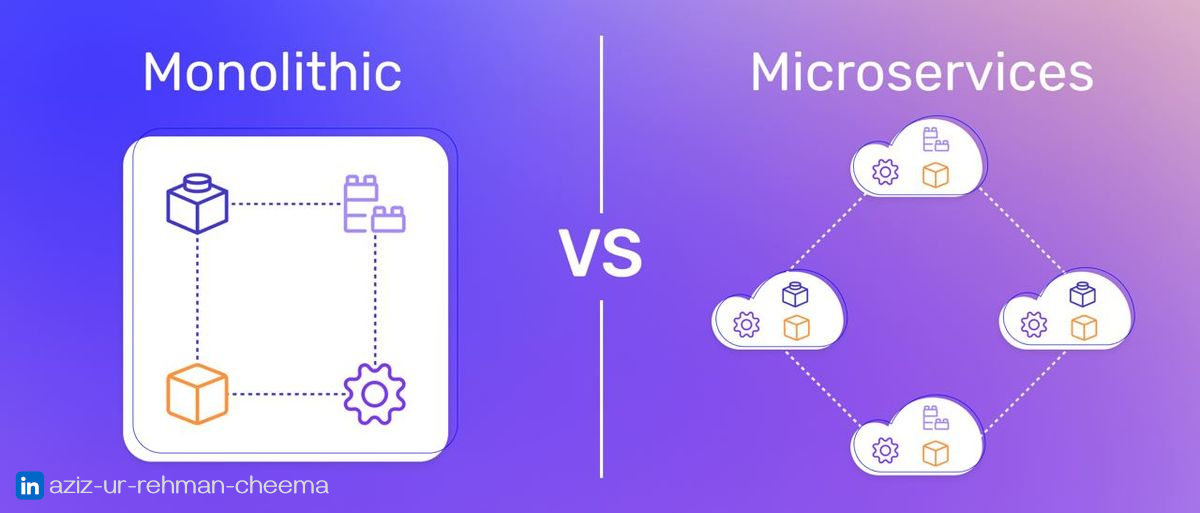
When you decide to build a website or a big application, you have to make a very important choice: how should the “brain” of the application be organized? In the world of software engineering, this is called Software Architecture.
The two most famous ways to organize your code are Monolithic and Microservices. If you are a student, a developer, or someone interested in how modern apps like Netflix or Amazon work, understanding the difference is key. In this guide, we will break down these two styles in simple terms.
What is a Monolithic Architecture?
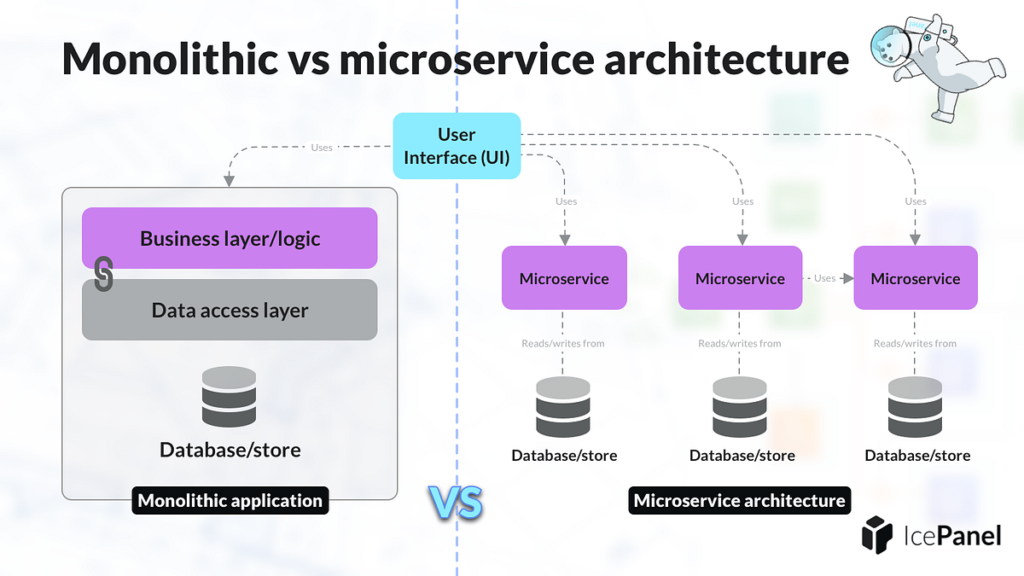
Think of a Monolithic application like a single, giant office building where every single department—marketing, sales, HR, and IT—is stuck in one big room.
In a monolith, all the parts of your application are packed into one single unit. If you are building an online store, the code for the homepage, the shopping cart, the payment system, and the user database are all bundled together in one big folder.
The Pros:
- Easy to start: When you are just beginning a project, it is much simpler to keep everything in one place.
- Simple testing: Because everything is in one file, it is easy to test the whole application at once.
- Fast communication: Since all the parts are in the same “room,” they can talk to each other instantly without any delay.
The Cons:
- Hard to update: If you want to change just one small thing (like the “Buy Now” button), you have to rebuild and redeploy the entire massive application.
- One crash ruins everything: If the payment system has a bug and crashes the whole thing, your entire website goes offline.
- Hard to grow: If your store becomes super popular, you can’t just scale the shopping cart; you have to copy the entire giant building, which wastes a lot of computer memory.
What is Microservices Architecture?
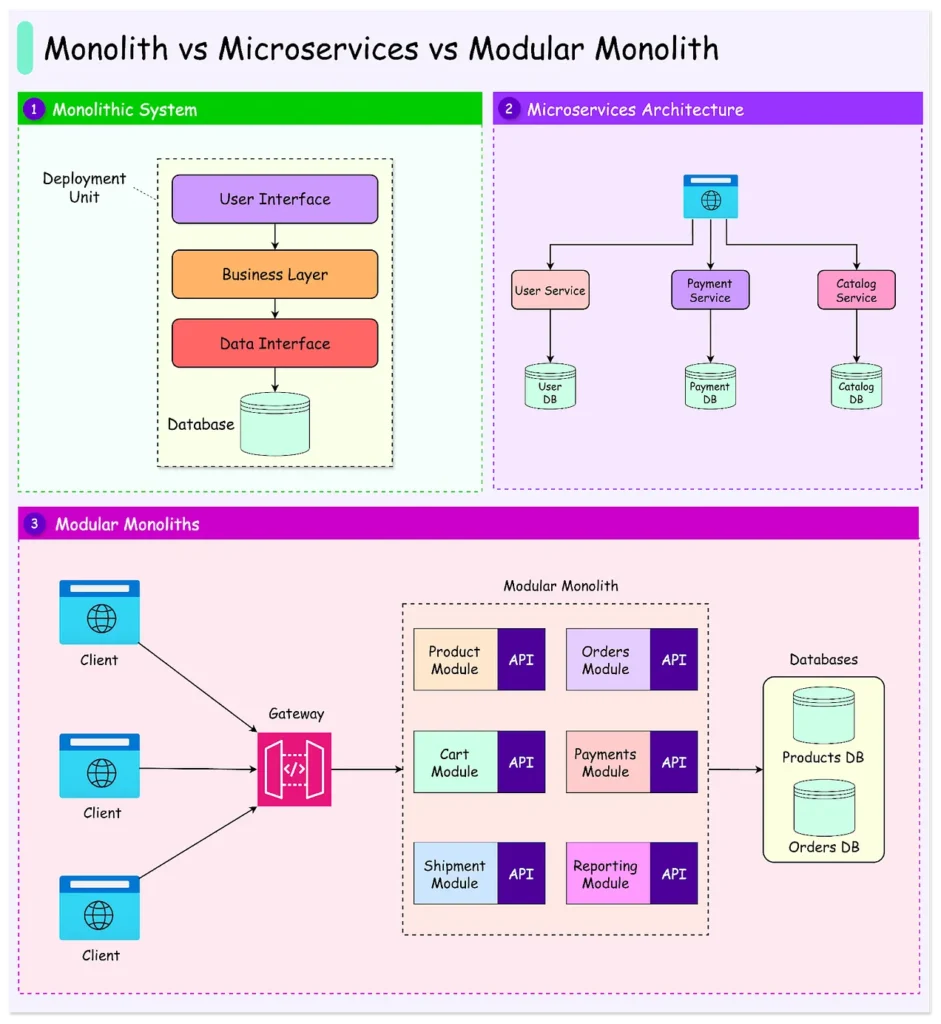
Now, imagine that same office building, but instead of one big room, every department has its own separate office in different parts of the city. They are connected by a super-fast internal phone system. This is Microservices.
In this style, you break your application into small, independent pieces. One service handles just the payments, another handles the product catalog, and a third handles user accounts. Each service can be built using different technologies.
The Pros:
- Independence: If the “Product Catalog” service has a bug, the “Payment” service keeps working perfectly. Your store stays online.
- Easy to scale: If thousands of people are shopping at once, you can just add more power to the “Payment” service without touching anything else.
- Flexibility: Different teams can work on different services at the same time without getting in each other’s way.
The Cons:
- High Complexity: Managing 20 small services is much harder than managing one big folder. You need a lot of extra work to make sure they all talk to each other correctly.
- Delayed Communication: Because the services are separate, they talk over a network, which is slightly slower than having everything in one file.
- Difficult to test: You have to make sure that a change in the “User” service doesn’t accidentally break the “Shipping” service.
Comparison at a Glance
| Feature | Monolithic | Microservices |
| Complexity | Simple to start | High complexity |
| Updates | All at once | Independent |
| Reliability | Risky (one bug can break all) | Robust (isolated failures) |
| Scaling | Scale the whole thing | Scale specific parts |
| Best For | Small startups/simple sites | Huge, growing apps |
Which One Should You Choose?
There is no “better” choice; there is only the choice that fits your needs.
Choose Monolithic if:
- You are a student or a small team building your first project.
- Your application is simple and doesn’t need to handle millions of users yet.
- You want to get your product to the market as quickly as possible.
Choose Microservices if:
- You are building a massive platform like a social media site or a giant e-commerce store.
- You have a large team of developers who need to work on different parts of the app simultaneously.
- You expect your traffic to grow rapidly and need to scale parts of your site independently.
Final Thoughts
In the tech world, we often see a trend where people start with a Monolithic structure to get their idea off the ground. As the application becomes successful and gains millions of users, they slowly transition parts of it into Microservices.
As a CTO or developer, your job isn’t to pick the “trendiest” architecture; it’s to pick the one that lets you build, test, and ship your code efficiently. Start simple, grow steadily, and choose the right tools for the right stage of your journey!