



For nearly two decades, Stack Overflow was the undisputed “brain” of the global developer community. If you were a programmer and you encountered a bug, your first instinct was to search for the error, find a question on Stack Overflow, and copy the accepted answer. It was a digital empire built on the collective knowledge of millions, organized into a clean, searchable, and community-vetted format.
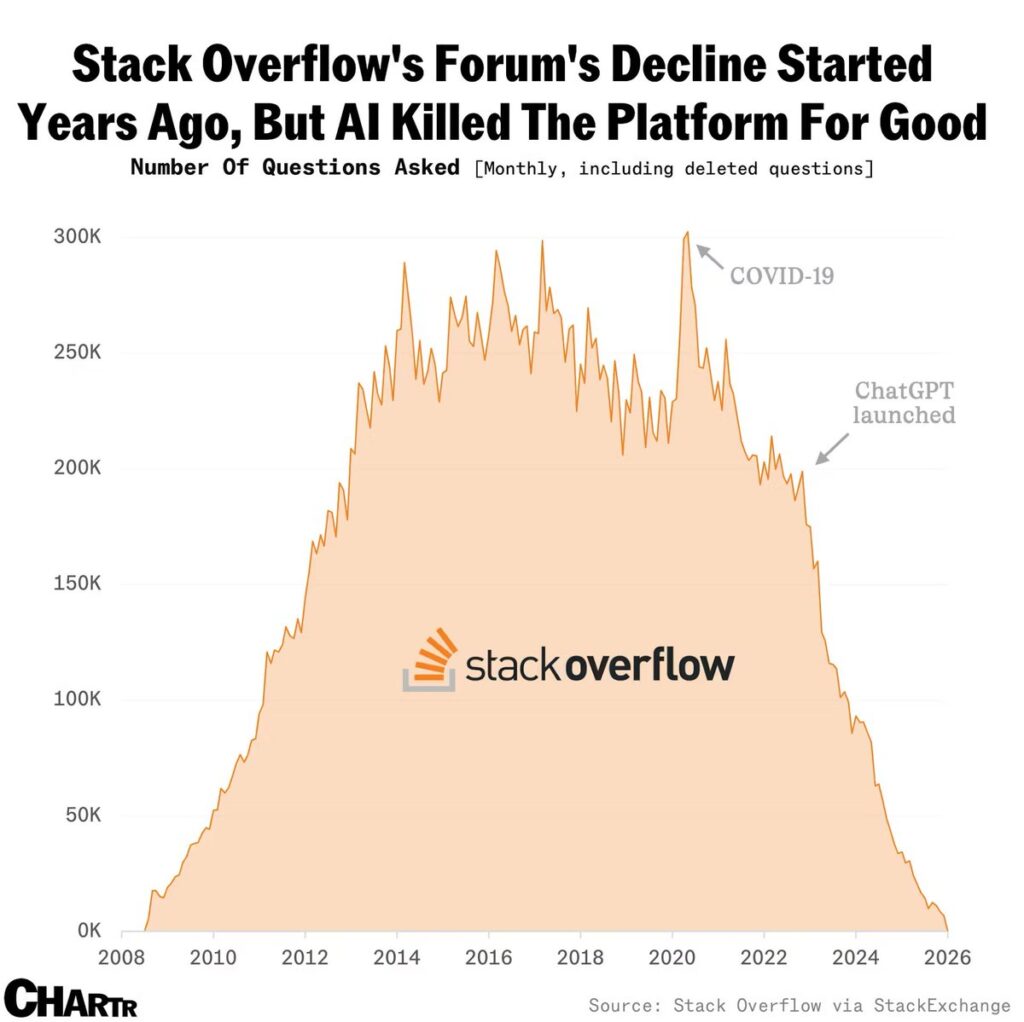
However, the rise of Generative AI—specifically Large Language Models (LLMs) like GPT-4, Claude, and specialized coding assistants—has fundamentally shattered the foundation of that empire. The decline of Stack Overflow is not just about a drop in traffic; it is about a shift in the very way humanity acquires technical knowledge.
The End of the “Copy-Paste” Workflow
In the pre-AI era, Stack Overflow thrived on the “copy-paste” developer culture. When a user faced an issue with a complex framework, they relied on a human expert to have already solved it. The community rewarded those experts with “reputation points” and “badges,” creating a gamified system that incentivized participation.
Generative AI destroyed this incentive structure overnight. When a developer can now ask an AI, “Why am I getting a null pointer exception in this specific React hook?” and receive a tailor-made code snippet that addresses their exact file structure, the need to search through 10-year-old forum threads vanishes. The AI provides an immediate answer, effectively turning the “human-to-human” knowledge transfer into a “machine-to-human” dialogue.
The Loss of Contextual Nuance
The real genius of Stack Overflow was its human element. Users didn’t just provide code; they provided context. They debated the “why,” warned about security pitfalls, and offered alternative solutions. It was an iterative, social process.
Generative AI, by contrast, is a synthesis machine. While it is incredibly fast, it lacks the lived experience of a community. By replacing the social forum with an AI interface, the developer community is losing the “collective wisdom” that comes from human disagreement and collaborative refinement. We are no longer learning from each other; we are simply extracting information from a model trained on our past contributions.
The Content Trap: Who Will Train the Next AI?
The irony of the AI-led decline of Stack Overflow is that these very LLMs were trained on the data provided by the Stack Overflow community. By making Stack Overflow less relevant, these AI models are effectively “eating” the platform that gave them the intelligence they now possess.
If the new generation of developers stops asking questions on Stack Overflow and relies solely on AI, the platform’s feed will stagnate. As the volume of new, human-vetted content decreases, the “freshness” of the knowledge pool declines. Eventually, the AI models themselves will suffer from “model collapse”—where they are forced to train on low-quality, AI-generated content instead of the high-quality, human-curated data that made them great in the first place.
The Shift from “Search” to “Synthesize”
The most profound change is the shift in developer behavior. We have moved from the Search Paradigm to the Synthesis Paradigm.
- Search Paradigm (Stack Overflow Era): You search for your problem, read multiple conflicting answers, judge which one is best, and apply it to your project.
- Synthesis Paradigm (AI Era): You feed your problem to an LLM, and it synthesizes the best answer based on its internal logic.
This shift makes the developer “smarter” in the short term, but arguably “lazier” in the long term. Many junior developers are now bypassing the struggle of understanding the underlying mechanism of their code, choosing instead to trust the AI’s output. This creates a generation of developers who can build apps but might struggle to fix them when the AI fails or the environment becomes too complex.
Is This the End of the Empire?
Stack Overflow is not “dead” in the literal sense, but its role as the gatekeeper of developer knowledge is effectively over. The platform has attempted to pivot by launching “OverflowAI,” trying to integrate AI features directly into the site, but it feels like a defensive maneuver against a tide that cannot be stopped.
The empire is being replaced by a more fragmented, personalized, and efficient reality. We are no longer living in a world of “public knowledge repositories”; we are living in a world of “private AI assistants.”
The Lesson for the Future
The fall of the Stack Overflow empire teaches us a harsh lesson about digital platforms: the moment a technology can provide a more efficient substitute for human collaboration, the community-based model becomes vulnerable.
Stack Overflow succeeded because it was faster than reading a textbook. AI is succeeding because it is faster than reading a forum.
As we move forward, the challenge for the developer community is to preserve the “human” element of coding. We need to find ways to keep collaborative, critical, and social technical discourse alive, even if the daily tasks of writing functions and debugging errors are handled by AI. If we lose the ability to argue about the “right way” to write a function, we will lose the very thing that makes software engineering an art rather than just a process.
Note for the Developer: This article reflects the current shift in the tech industry as of 2026. If you are writing this for wpdata.in, ensure you link it to your articles on React or JavaScript to show how developers are changing their workflow in real-time.