



When embarking on a web development project, the most critical decision you will make is selecting your frontend framework. The “Big Three”—React, Angular, and Vue.js—dominate the industry. Each offers a different approach to building user interfaces, and choosing the “best” one depends entirely on your project goals, your team’s expertise, and the complexity of the application you are building.
In this article, we will break down these three powerhouses to help you decide which one deserves to be the foundation of your next project.
1. React: The Flexible Giant
Created by Meta (Facebook), React is not technically a framework; it is a library focused entirely on the “View” layer.
- The Philosophy: React uses a component-based architecture. You build small, reusable pieces of UI and combine them to create complex interfaces. It utilizes JSX (JavaScript XML), which allows you to write HTML-like structures directly inside your JavaScript code.
- The Pros: It has the largest ecosystem in the world. If you encounter a problem, someone else has likely already solved it. Because it is a library, it is highly flexible; you can choose your own routing, state management, and testing tools.
- The Cons: Because it is “unopinionated,” you have to make many architectural decisions yourself (like how to handle routing or global state), which can be overwhelming for beginners.
- Best For: Dynamic applications where flexibility and a massive community are prioritized. It is the go-to choice for companies scaling large, complex products.
2. Angular: The Full-Featured Powerhouse
Developed by Google, Angular is a comprehensive, opinionated framework. Unlike React, it provides everything you need “out of the box.”
- The Philosophy: Angular is built on TypeScript, and it follows a strict structure (Model-View-Controller). It includes its own routing, form handling, and HTTP client modules by default. It is designed to be the “batteries-included” solution for enterprise software.
- The Pros: Because it is so structured, it is excellent for large teams working on massive applications. Everyone follows the same rules, which makes the codebase easier to maintain over time. It also features powerful “Two-Way Data Binding,” which automatically syncs your UI with your data.
- The Cons: It has a very steep learning curve. The syntax and concepts (like Modules, Injectables, and RxJS) can be intimidating for those used to simpler JavaScript workflows. It is also quite “heavy,” which can lead to larger file sizes.
- Best For: Enterprise-grade applications, large-scale systems, and teams that prefer strict architectural standards over flexibility.
3. Vue.js: The Progressive Approach
Vue.js, created by Evan You, is often described as the “Goldilocks” framework. It takes the best parts of React and Angular and blends them into something approachable and fast.
- The Philosophy: Vue is “progressive,” meaning you can start small by just dropping it into a simple webpage, or you can scale it up into a full-featured application using the Vue ecosystem. It separates your template (HTML), logic (JavaScript), and styles (CSS) into clear, readable blocks.
- The Pros: It is widely considered the easiest to learn. The documentation is industry-leading, and the syntax is very intuitive. It is also extremely performant, often beating both React and Angular in raw rendering speed for many common tasks.
- The Cons: While its ecosystem is growing, it is smaller than React’s. Additionally, because it offers so many ways to do things (Options API vs. Composition API), teams sometimes struggle to maintain consistency in how code is written.
- Best For: Fast-moving startups, developers who want to be productive quickly, and projects that require high performance with a low barrier to entry.
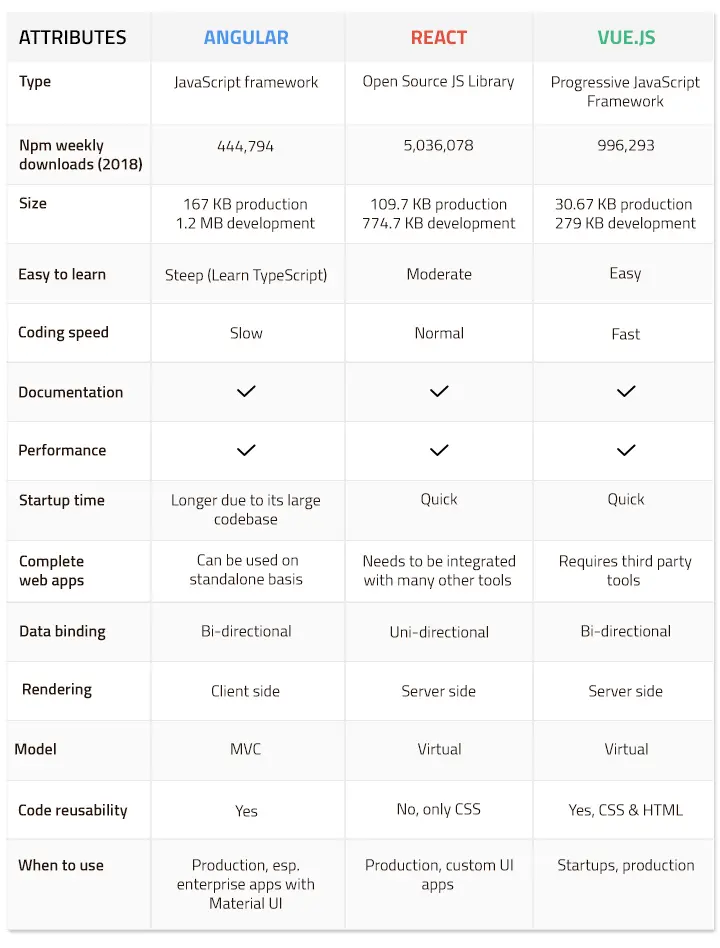
Comparison at a Glance
| Feature | React | Angular | Vue.js |
| Foundation | Library (UI only) | Full Framework | Progressive Framework |
| Learning Curve | Medium | High | Low |
| Language | JavaScript/JSX | TypeScript | JavaScript/HTML |
| Ecosystem | Massive | Large (Integrated) | Growing/Balanced |
| Architecture | Component-based | MVC (Structured) | Component-based |
Which One Should You Choose?
- Choose React if: You want to join a massive job market, prefer a flexible architecture, and love having thousands of third-party plugins available at your fingertips.
- Choose Angular if: You are building a large-scale enterprise application where stability, strict structure, and an “all-in-one” approach are required to manage a large team of developers.
- Choose Vue.js if: You want to build high-performance applications quickly. It is the perfect choice for those who find Angular too complex and React too unstructured.
Final Thoughts: The “Best” is Subjective
There is no “best” framework in a vacuum. A framework is a tool, and the best tool is the one that solves your problem most efficiently.
- If you are a student, Vue.js will give you the fastest path to building a working project.
- If you are looking for a career in top tech firms, React is the standard.
- If you are building complex systems that need to last for a decade, Angular is the professional choice.
Ultimately, focus on learning the core principles of JavaScript first. Once you understand how data flows, state changes, and how the Document Object Model (DOM) works, picking up any of these frameworks becomes much easier. The best developer is not the one who knows only one framework, but the one who knows how to learn the right framework for the job at hand.