



The JavaScript Revolution: How a 10-Day Script Conquered the Web
In 1995, a developer named Brendan Eich created a language called Mocha—later renamed JavaScript—in just 10 days. It was intended to be a simple “glue” language to make web pages slightly more interactive, like adding a popup alert or changing a background color. Today, that “10-day experiment” is the undisputed ruler of the digital world. JavaScript now powers everything from simple blogs to massive platforms like Netflix, PayPal, and Uber.
How did a language born from a rush job become the most popular programming language on the planet? The answer lies in a mix of historical luck, constant evolution, and the rise of the browser as the world’s most powerful software platform.
1. The Browser Monopoly: The Right Place, At the Right Time
The primary reason for JavaScript’s dominance is its exclusive position in the web browser. Since the late 90s, every single web browser—Netscape, Internet Explorer, Chrome, and Firefox—shipped with a built-in JavaScript engine.
Developers didn’t have a choice; if you wanted to run code in a browser, you had to use JavaScript. This created a massive “network effect.” Because everyone was forced to use it, everyone learned it. Because everyone learned it, more tools were built for it. It became the default language of the internet simply because it was the only language the internet could understand.
2. The Great Shift: From Client to Server
For the first decade of its life, JavaScript was strictly a “client-side” language—it lived only in your browser. The “server-side” (the logic that talks to databases) was dominated by languages like PHP, Java, and Python.
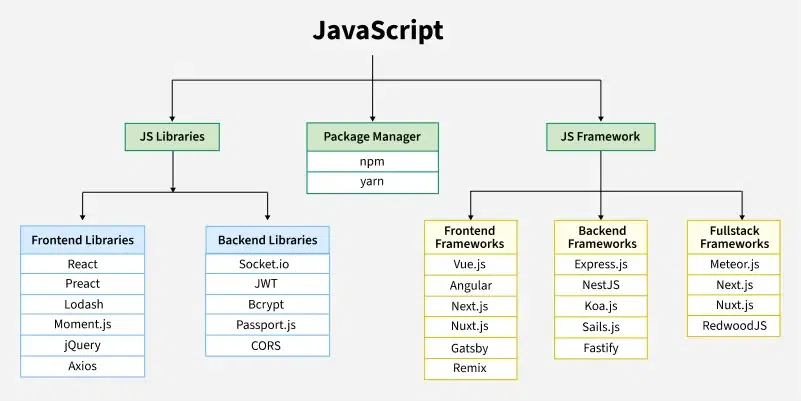
Everything changed in 2009 with the release of Node.js. By taking the JavaScript engine from Chrome (V8) and placing it on the server, Node.js allowed developers to use one single language across their entire tech stack. Suddenly, a startup didn’t need a team of Java experts for the backend and JavaScript experts for the frontend. One developer could do it all. This “Full Stack” revolution made JavaScript an incredibly efficient choice for businesses, driving its popularity through the roof.
3. The “Framework” Explosion
JavaScript’s ability to reinvent itself is unmatched. When developers complained that raw JavaScript was too difficult to manage for large apps, the community responded with frameworks.
- jQuery (2006): It made interacting with the page so easy that it became a standard for nearly every website in existence.
- Angular, React, and Vue (2010s): These frameworks introduced the “Component-based” architecture. They allowed developers to build highly complex, dynamic apps that felt like desktop software. This changed the web from a collection of static “documents” into a collection of “applications.”
This constant cycle of innovation meant that whenever a new web challenge emerged, the JavaScript community was usually the first to solve it.
4. The Power of the “npm” Ecosystem
The npm (Node Package Manager) registry is arguably the biggest reason for JavaScript’s continued growth. It is a massive library where developers share their code. If you need a function to handle dates, generate charts, or connect to a payment gateway, there is already an “npm package” for it.
This ecosystem fosters a culture of sharing. A developer can build a feature in an afternoon by combining existing code from thousands of other contributors. This speed of development is unparalleled, making JavaScript the fastest language for prototyping new ideas.
5. It is No Longer Just for the Web
JavaScript has escaped the browser entirely. Today, you can use it to build:
- Mobile Apps: Using frameworks like React Native, you can build iOS and Android apps using JavaScript.
- Desktop Apps: Tools like Electron allow you to build desktop software (like VS Code, Slack, and Discord) using web technologies.
- Internet of Things (IoT): You can even run JavaScript on microcontrollers to control hardware and robots.

By becoming a “universal” language, JavaScript has moved from being a “web-only” tool to a skill that is valuable in virtually every sector of technology.
Why JavaScript is Here to Stay
Some critics often claim that JavaScript is “messy” or “too complicated.” While it has its flaws, its popularity persists because of its accessibility. You don’t need an expensive compiler or a powerful computer to start coding in JavaScript—you just need a web browser.
For a student or a new developer, the path to building something “real” is shorter in JavaScript than in almost any other language. You write a line of code, refresh your browser, and you see the result. That instant gratification is addictive, and it is how millions of developers get hooked on programming.
Conclusion: The Language of the Future
JavaScript succeeded because it adapted. It survived the browser wars, it embraced server-side computing, and it fostered an ecosystem of shared knowledge that is larger than any other in history.
As we look toward 2026 and beyond, JavaScript continues to evolve with features that make it faster and safer, such as TypeScript (which adds structure to the language). Whether you are building a simple portfolio or a massive global platform, JavaScript remains the most versatile, widely supported, and essential tool in a developer’s toolkit. It didn’t just become popular—it became the language of the modern world.