



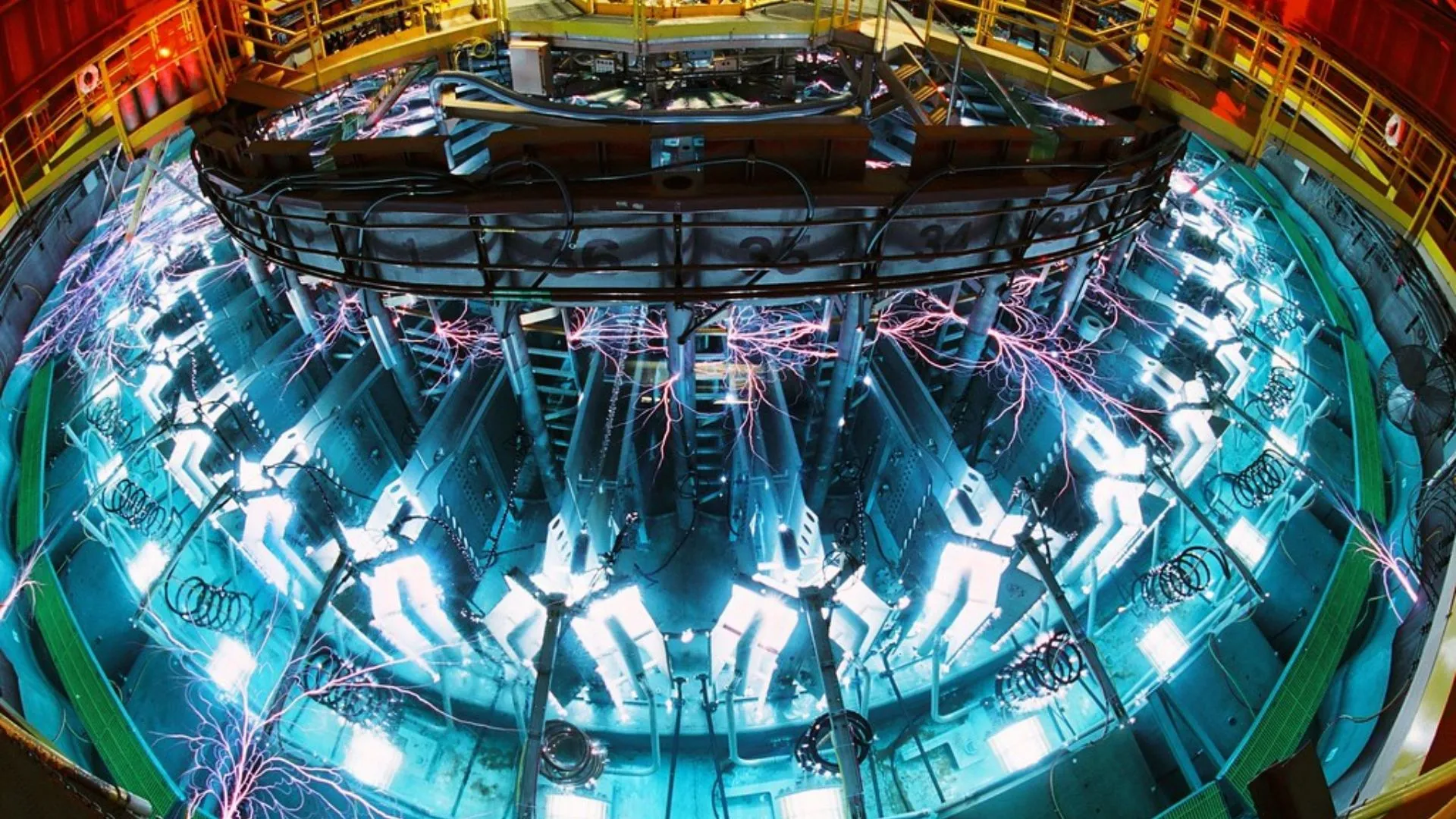
Imagine a world where your phone never needs a charger, factories run without emitting a single puff of black smoke, and electricity bills drop to next to nothing. This sounds like a sci-fi movie, but a recent breakthrough by a clean-energy startup called Pacific Fusion has brought us one step closer to this reality.
In June 2026, the company tested a new machine that successfully packed 440 Gigawatts of power into a tiny burst lasting just 80 nanoseconds.
To understand how massive this is, think of India’s entire national electricity grid. The maximum power India’s grid handles at any peak moment is around 240 to 250 Gigawatts. Pacific Fusion generated nearly double that amount of power in a fraction of a second!
Let’s break down the science behind this news, why it is turning heads globally, and what it means for the future of our planet.
The Holy Grail of Energy: Nuclear Fusion
To understand the breakthrough, we first need to look at the physics. Today, all our nuclear power plants use Nuclear Fission—the process where a heavy atom (like Uranium) splits into smaller atoms, releasing energy. While efficient, fission creates radioactive waste that stays dangerous for thousands of years.
Pacific Fusion is working on the exact opposite: Nuclear Fusion. This is the process where light atoms (like isotopes of Hydrogen) are forced to join together to form a heavier atom (Helium). This is the exact same chemical and physical reaction that powers our Sun and the stars.
Fusion is considered the “Holy Grail” of energy because:
- Its fuel comes from ordinary water.
- It produces zero greenhouse gases.
- It leaves behind absolutely no long-term radioactive waste.
However, there is a catch. To make atoms fuse on Earth, you need to create temperatures hotter than the core of the sun—around 100 million degrees Celsius! At this temperature, matter turns into plasma (a soup of free-floating ions and electrons).

The Traditional Problem vs. Pacific Fusion’s New Way
Usually, scientists try to control this super-hot plasma using two main methods:
- Magnetic Confinement: Using giant, incredibly expensive magnets to trap the plasma in a donut-shaped machine called a Tokamak.
- Inertial Confinement: Using the world’s largest and most expensive lasers to shoot at a tiny fuel pellet to compress it.
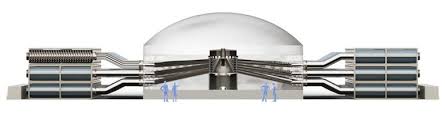
Both methods cost billions of dollars and require machines the size of football stadiums. This is where Pacific Fusion did something unique. Instead of massive lasers or giant magnets, they used a method called pulsed-power technology.
Instead of a steady beam, their machine stores up electricity and releases it in a violent, ultra-fast shockwave—a “pulse”—lasting only 80 nanoseconds (an 80-billionth of a second).
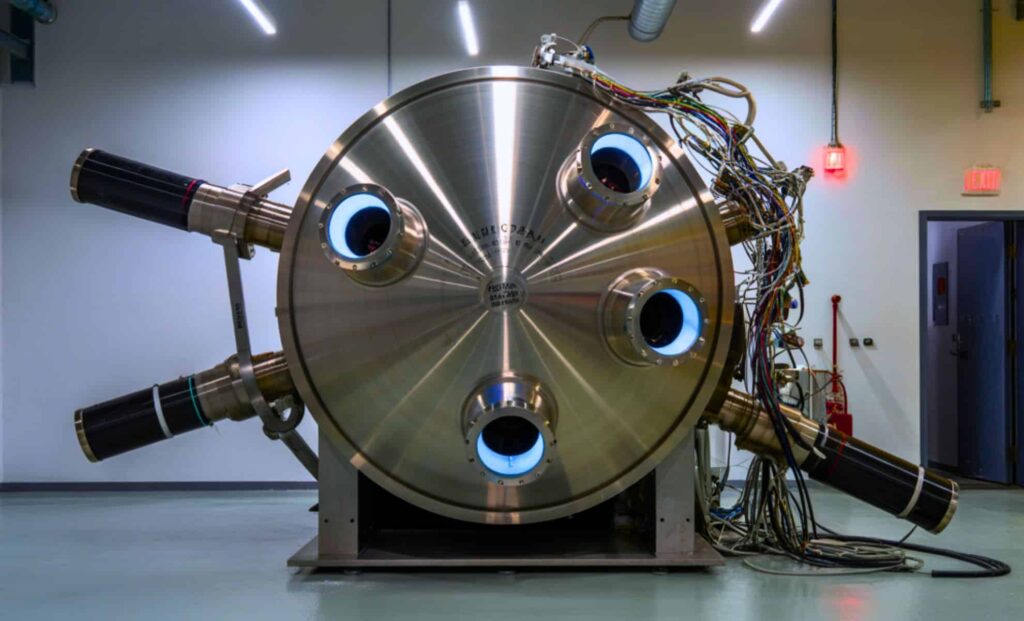
When this massive electric current hits the fuel container (which is surprisingly made of cheap materials like aluminum and plastic), it creates its own powerful magnetic field. This magnetic field instantly crushes the hydrogen fuel inward, heating it up to fusion temperatures.
Why is this a Big Deal for Class 12 Students?
If you open your Class 12 Physics textbook, you will find chapters on Moving Charges and Magnetism and Nuclei. You learn that a current-carrying conductor creates a magnetic field around it, and you learn about Einstein’s famous equation, $E = mc^2$, which explains how mass converts into energy during nuclear reactions.
Pacific Fusion’s experiment is a real-world application of these exact textbook formulas! By using Ampere’s Law and the concepts of magnetic pressure, they managed to eliminate the need for multi-billion-dollar magnets. They proved that we can create the extreme conditions needed for fusion using a machine that is much smaller, cheaper, and easier to mass-produce in factories.
The Road Ahead
While a 440-Gigawatt burst sounds incredible, we aren’t running our homes on fusion energy just yet. The burst lasted for an incredibly short time. The next big challenge for the company is to figure out how to repeat these bursts multiple times a second, continuously, to create a steady stream of electricity.
With over $900 million in funding and a successful prototype, Pacific Fusion has shown that clean, unlimited energy isn’t just a dream for the next century. It might happen in our lifetimes—and it all started with a flash of light that lasted less than a microsecond.